
COLUMN A) Employee Number – The employee number can be any alphanumeric combination you choose. Zeros can be added to the beginning of an Employee Number to create a uniform number of characters across all employees. This creates a uniform look and keeps the order consecutive. If you are using our HR solution, a new employee number will be created by that module once your information has been imported.
COLUMNS B-E ) Name and address – There are no specific formatting requirements in these fields.
COLUMN F) Zip Code – This should be imported as a .txt file to avoid issues with zip codes starting with a zero (0). Excel will not import a leading zero and will end up giving you a four-digit code. Using a .txt file will avoid these errors. Nine-digit zip codes are also acceptable.
COLUMN G) City – No specific formatting requirements for this field.
COLUMN H) State – This must be the two-letter abbreviation for the state in capital letters. For example, Washington should be WA, not Wash., Washington, or washington.
COLUMN I) Social Security Number – The social security numbers should be formatted with dashes after the third and fifth digits (i.e.: 123-45-6789). The column can be formatted for this by right clicking the column header displaying the letter I. Select “Format Cells” from the dropdown menu. Select “Special.” In the “Type” box, click on “Social Security Number.” Now the column will use the correct formatting for the way the SSNs will need to be entered on employees’ W4s.


COLUMN J) Phone Number – This field can be entered in any 10-digit format.
COLUMN K) Birth Date – No specific formatting requirements for this field.
COLUMN L) Hire Date – No specific formatting requirements for this field. The Hire Date is their first day worked / the starting date. There will be a field for Adjusted Hire Dates later in this template. If an employee goes on extended leave or is terminated and rehired, the day they come back will be listed in the Adjusted Hire Date column.
COLUMN M) Marital Status – This field is optional depending on if your organization tracks this metric or not. The options are Single, Married, or Filing Separately. This is not related to tax filing.
COLUMN N) Gender –The options are Male, Female, Not Specified, and Non-Binary. If you do not track Gender in your organization, simply enter Not Specified for all employees. Be sure to spell and capitalize your entries as shown.
COLUMN O) Statutory Employee – This needs to be filled in with as True or False depending on the employee’s status. If the employee is an independent contractor who is considered an employee for tax withholding purposes, enter True. This will trigger the system to mark that box on the employee’s W2. All other employees should be entered as False.
COLUMN P) Email – If you will be a.) contacting your employees by email, b.) using our HR solution, or c.) using Employee Self Service, every employee will need to have a unique email address. For example, if there are spouses who share an email address and both are employed by your organization, they will need to create a second email address for one of them to use.
COLUMN Q) Global Dimensions 1 Code – This is the Global Dimensions 1 Code that has been set up in Business Central.
COLUMN R) Global Dimensions 2 Code – This is the Global Dimensions 2 Code that has been set up in Business Central
COLUMN S) Payroll Division – This field is for those not using our HR solution. This is optional and depends on if your organization utilizes Payroll Divisions. If so, fill in up to 20 characters of freeform text. If you will be using Payroll Divisions, you will need to have them set up before importing your data so please discuss this with your Implementation Specialist. An example of a Payroll Division would be an organization who offers paid time-off plans for certain groups of employees; these employees could be grouped into a separate Payroll Division.
COLUMN T) Employee Posting Group – This field is required. If Posting Groups have not been identified, simply fill in this field for each employee with “All”. If this changes, the information can be populated at a later time. If you are currently using multiple Posting Groups, discuss it with your Implementation Specialist. This would be used if you have multiple general ledger accounts and post specific groups of employees (i.e., Sales) to a separate general ledger account.
COLUMN U) Suffix – This is optional. You may enter any abbreviation up to three characters. For example, Jr., Sr, III.
COLUMN W) Middle Name – This field is optional.
COLUMN X) SUTA/Income Tax State – This needs to be entered as the capitalized, two-letter abbreviation for the state to which the employee’s unemployment tax is paid. Using other abbreviations or spelling out the states’ names will cause an error.
COLUMN Y) Payroll Calendar Code – This will only be populated for salaried employees if you want to break out the Holiday Pay. This field is optional.
COLUMN Z) Workers Comp Code – Please notify your Implementation Specialist if you are tracking Workers Comp and want it associated to the employee and not the job so they can set up those codes for you. Once the codes have been established in your new system, fill in the appropriate information here.
COLUMN AA) Default Company Code – This field is optional. This field will require additional customization if you are using a Default Company Code. Please discuss this with your Implementation Specialist. This is typically used when an organization is running two FEINs under a single system.
COLUMN AB) Job Title – This field is freeform and can hold up to 50 characters.
COLUMN AC) Employee Type – Information here needs to be entered exactly as the options are shown in the drop-down menu. The options are Fulltime, Parttime, Intern/Other, Seasonal. As an example, if you enter Full time or fulltime, it will not import so please be attentive to the way these fields are filled in.
COLUMN AD) Adjusted Hire Date – This is the start date of an employee returning from extended leave (i.e., FMLA or Parental leave) or if they have been re-hired after a termination.
COLUMN AE) Termination Date – Enter the employee’s final day with the company.
COLUMN AF) Opt-in 1095C Email – Does the employee want to receive their 1095C electronically via email? If yes, mark True. If they prefer a paper copy, mark False.
COLUMN AG) Cell Phone Number – This is an optional field and can be entered in any 10-digit format.
COLUMN AH) Paperless W2 Opt-in – If the employee would like to receive an encrypted W2 sent to their unique email address, instead of a paper copy through the USPS, mark True. If they want a hard copy in the mail, mark False.
COLUMN AI) EEO Code – Equal Employment Opportunity Code uses a standard format in the U.S.A.; Canada uses different codes. This is not a required field if you are not filing an EEO report.
COLUMN AJ) Payroll Status – In order to create an employee in the new system, they need to be imported as active. As a result, you will import everyone as active employees. Once they are in the system you can use the Inactive Date and Termination Date to find the employees who are not active and update their status at that time.
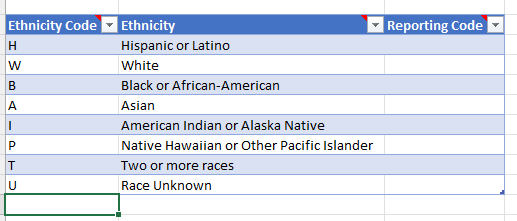
COLUMN AK) Ethnicity Code – This is an optional field. If your organization tracks this information, use the abbreviations below.
COLUMN AL) Not Eligible for Rehire – This field must be filled out for each employee. Use True or False.
COLUMN AM) Mark W2 Retirement Plan – This field must be filled out for each employee. Use True or False.
COLUMN AN) Mark W2 3rd Party Sick Pay – This field must be filled out for each employee. Use True or False.
Questions / Resources
If you have questions or comments please email support@integrity-data.com.
Last Review: 6/20/2023
Leave A Comment